

The operation is often the part people prepare for most. The scans are done, the surgeon has explained the procedure, and the date is set. What tends to get less attention is what happens after you leave the operating theatre, even though that is where much of the day-to-day work of recovery takes place.
A joint replacement, a ligament repair or a fracture fix gives the body a chance to heal. It doesn't restore strength, balance or confidence on its own. Muscles weaken quickly when a limb is protected or rested, joints stiffen, and many people become nervous about moving the operated area. Structured rehabilitation, whether at home or at a rehabilitation centre, is how most people work through all of this in a safe, guided way.
This article explains what rehabilitation after orthopedic surgery involves, what a typical programme may look like, and how to think about choosing the right support. It is general information, not medical advice, and your surgeon's instructions always come first.
What does rehabilitation after orthopedic surgery mean?
Orthopedic surgery covers procedures on bones, joints, ligaments, tendons and muscles. Common examples include knee or hip replacement, ACL reconstruction, rotator cuff repair, fracture fixation with plates or rods, and some spine procedures.
Rehabilitation is the planned process of regaining movement, strength and function after such a procedure. It usually involves a physiotherapist working closely with the surgical team, and sometimes occupational therapists, nurses or other specialists. The programme is built around what was done in surgery, the surgeon's protocol, and the person's own health and daily needs.
People sometimes picture rehabilitation as a set of exercises handed over on a sheet of paper. In practice it is broader than that. It includes pain and swelling management, guidance on how to move and what to avoid, gradual strengthening, walking and balance training, and help with returning to work, sport or everyday routines.
Why rehabilitation matters after surgery
Surgery repairs a structure. Rehabilitation helps the rest of the body catch up around it.
After an operation, some muscles often become weaker because the area has been protected, painful or less active. Scar tissue forms as part of normal healing, and without gentle, guided movement it can sometimes limit how far a joint bends or straightens. Walking patterns may change as the body compensates for pain or a brace, and those habits can linger if they aren't addressed.
A well-planned programme aims to support each of these areas gradually. It can also help people understand what is normal during recovery, such as some soreness or swelling, and what needs a call to the surgeon. That reassurance matters more than it might sound. Fear of damaging the repair is common, and having a professional explain what is safe to do can make the process less stressful.
How much benefit a person gets depends on many things: the type of surgery, age, general health, how well the programme is followed, and how the body heals. Outcomes can vary between individuals, and nobody can promise a specific result.
What a rehabilitation programme may involve
Every surgeon has their own protocol, so the details differ. Broadly, though, recovery tends to move through stages, and a physiotherapist can adjust the pace to your progress rather than a fixed calendar.
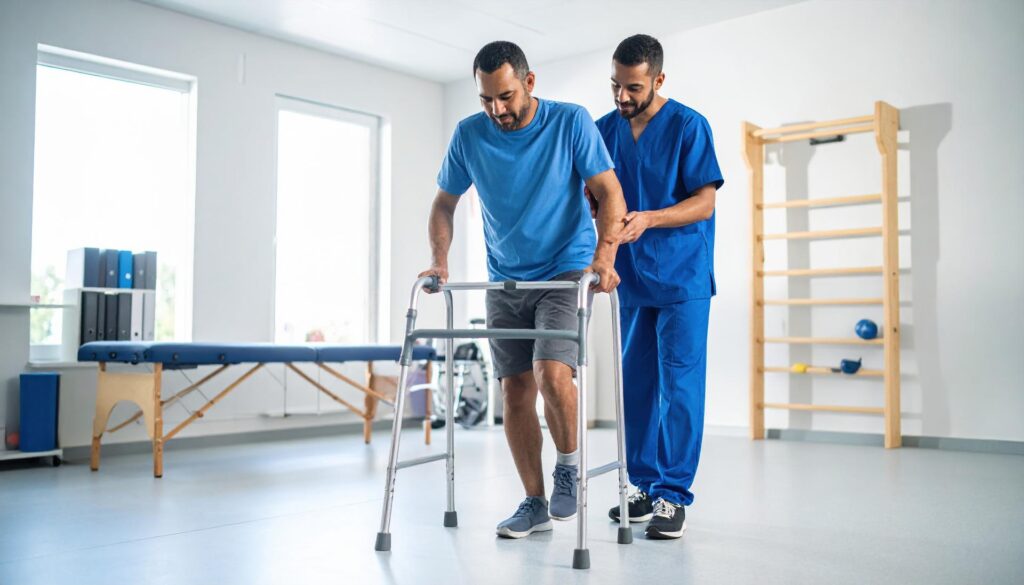
The early phase. The focus is usually on protecting the surgical site, controlling pain and swelling, and starting gentle movement as your surgeon allows. You may be taught how to get in and out of bed, use a walker or crutches, or manage stairs safely. Some operations come with weight-bearing limits, meaning how much load you can put on the leg, and these need to be followed carefully.
The middle phase. As healing progresses, the emphasis often shifts to improving range of motion and building strength in the muscles around the joint. Balance and walking training usually become part of the routine here.
The later phase. Exercises tend to become more demanding and more specific to the person's goals. For someone returning to office work, that may mean sitting tolerance and stamina. For an athlete or a keen gym-goer, it may involve sport-specific movement. For an older adult, it may centre on confidence, balance and independence at home.
Support may include hands-on techniques, supervised exercise, movement analysis and education on home exercises. Which of these are appropriate depends on your surgery and your surgeon's guidance.
Where rehabilitation takes place, and the role of a rehabilitation centre
Rehabilitation after orthopedic surgery isn't tied to one setting. Where it happens depends on the type of surgery, how much help a person needs, and what the surgical team recommends. Broadly, there are four common arrangements:
At home: A physiotherapist teaches a home exercise programme and reviews progress at set intervals. This tends to suit people who are fairly independent and can follow the plan safely.
Outpatient sessions: The person attends a clinic or hospital for scheduled visits, usually a few times a week, and continues exercises at home in between.
Inpatient rehabilitation: After some major procedures, or when other health conditions make recovery more complex, a person may stay for a period in a hospital rehabilitation unit where therapy is part of the daily routine.
A rehabilitation centre: A rehabilitation centre brings physiotherapy, supervised exercise, specialised equipment and a team of professionals together in one place, which can make regular, structured sessions easier to keep up.
None of these is better in every situation. The right choice depends on the surgery, the person's health, their home environment, and the surgeon's advice.
Whichever setting is used, it helps to understand the plan. Questions worth asking your care team include:
1. Is the programme based on my surgeon's protocol and my own assessment?
2. Who will be guiding my sessions, and how will my progress be reviewed?
3. What should I do at home, and what should I avoid?
4. Who do I contact if something doesn't feel right?
It is also worth knowing that healing doesn't follow a fixed schedule. Be cautious of anyone who promises a specific recovery time or a guaranteed result.
Who may benefit from rehabilitation
Post-surgical rehabilitation may be considered for people who have had:
Joint replacement surgery, such as knee or hip replacement
Ligament or tendon repair, including ACL and rotator cuff procedures
Fracture surgery involving plates, screws or rods
Certain spine procedures, where the surgeon recommends a structured programme
Other bone or joint surgery, where regaining movement and strength is a goal
It may also be useful for people who feel unsure about moving after surgery, those whose daily routine makes recovery harder to manage alone, and older adults who want support with balance and independence. Whether rehabilitation is needed, and what kind, is a decision for you, your surgeon and your physiotherapist together.
Making the most of your recovery
Some habits tend to help, whichever setting you recover in:
1. Follow your surgeon's instructions on movement, weight-bearing, wound care and medication exactly as given. Don't stop or change any prescribed treatment without speaking to your doctor.
2. Do your home exercises regularly, and tell your physiotherapist if something feels too hard or too easy.
3. Expect progress to be uneven. Good days and flat days are common.
4. Look after the basics: rest, balanced meals, enough fluids, and sleep.
5. Ask questions. If you don't understand why you are doing an exercise, say so.
When to contact your doctor
Some symptoms need prompt medical attention rather than waiting for the next session.
Contact your surgeon or doctor if you notice:
1. Increasing redness, warmth, swelling or discharge around the wound
2. Fever or chillsPain that is getting worse instead of gradually easing, or pain not relieved as your doctor advised
3. Swelling, tenderness or pain in the calf, which can sometimes signal a blood clot
4. New numbness, tingling or colour change in the limb
Sudden chest pain or breathlessness is an emergency. Seek urgent medical care immediately.
Medical terms explained
A few words come up often during recovery. Here is what they usually mean:
Range of motion: how far a joint can bend or straighten.
Weight-bearing: how much of your body weight you are allowed to put through the operated limb. Your surgeon will tell you if there are limits.
Scar tissue: the tissue the body forms as it heals. Some are normal, but it can feel tight if movement is limited.
Gait: the way a person walks.
Physiotherapist: a trained healthcare professional who helps people restore movement and function through exercise, education and hands-on techniques.
Deep vein thrombosis (DVT): a blood clot in a deep vein, usually in the leg. It can be more likely after surgery or periods of reduced movement, which is why leg swelling or pain should be reported to a doctor.
A final word
Recovery after orthopedic surgery is rarely quick and rarely a straight line, but it doesn't have to be something you manage alone. Guided rehabilitation, whether through a rehabilitation centre, outpatient physiotherapy or a mix of both, gives you a structured way to rebuild movement and confidence at a pace your body can handle.
If you have had surgery or are planning one, talk to your surgeon about what rehabilitation will involve for you. A qualified healthcare professional can assess what is suitable in your situation and help you plan the next steps.
This blog is for general information only and is not a substitute for professional medical advice, diagnosis or treatment. Always consult a qualified healthcare professional about your own condition.
Nidhal
Excellent insights on advanced orthopedic and sports rehabilitation. A personalised approach that focuses not only on reducing pain but also on restoring mobility, strength, movement quality, and performance can make a significant difference in long-term recovery. Great resource for anyone looking to understand rehabilitation beyond simply treating the symptoms.